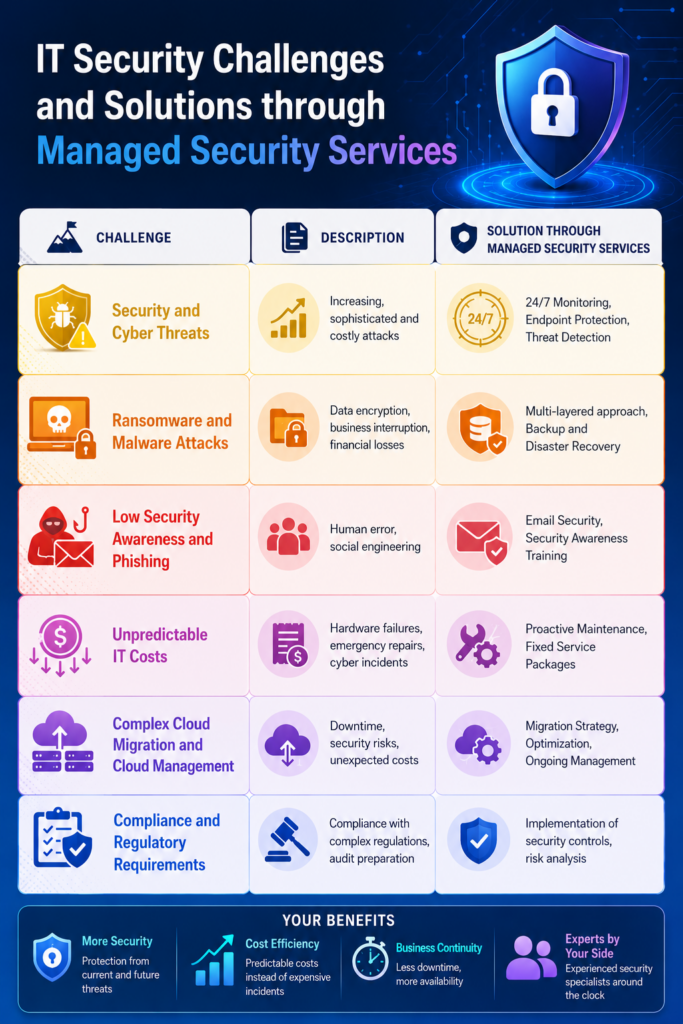
Cybersecurity has become far more complex than simply protecting an on-premises server. Today’s workforce is distributed, with employees accessing business systems from home, on the road, and across multiple devices and cloud applications. At the same time, cybercriminals are becoming more sophisticated. Phishing attacks, ransomware, credential theft, and exploits targeting remote access tools continue to rise, putting small and mid-sized businesses at greater risk due to limited IT resources.
Organizations in regulated industries face additional pressure to meet compliance requirements, maintain detailed audit logs, and implement robust security controls – all while supporting day-to-day business operations. As threats evolve and compliance demands increase, many businesses turn to managed security providers.
Partnering with a managed services provider gives your business access to specialized expertise, advanced technologies, and proactive support without the cost of expanding your internal team. Whether it’s managing cloud environments, strengthening cybersecurity with services like managed detection and response, or optimizing IT operations, an MSP can handle critical day-to-day functions while enabling your internal IT staff to focus on strategic initiatives that drive business growth.
Top IT Security Pain Points Managed Security Services Solve
1. Security and Cybersecurity Threats
Cybersecurity threats are becoming more frequent, sophisticated, and costly for businesses of all sizes. From phishing attacks and ransomware to data breaches and insider threats, a single security incident can disrupt operations, damage customer trust, and result in significant financial losses. As cybercriminals continue to refine their tactics, organizations need continuous monitoring, rapid threat detection, and a proactive security strategy.
Managed service providers help strengthen your security resilience by delivering 24/7 monitoring, endpoint protection, vulnerability management, threat detection and response, and regular security updates. With access to specialized cybersecurity expertise and robust security tools, businesses can detect threats earlier, minimize risk, and respond more effectively while allowing their internal IT teams to focus on strategic priorities.
2. Ransomware and Malware Attacks
Ransomware and malware remain among the most damaging cyber threats facing businesses today. A successful attack can encrypt critical data, disrupt operations, halt essential services, and result in costly downtime, financial losses, and reputational damage. Managed service providers help reduce this risk through a layered cybersecurity approach that includes advanced threat detection, continuous threat hunting, endpoint protection, vulnerability management, and strict access controls. They also implement reliable backup and disaster recovery solutions, ensuring critical data can be restored quickly in the event of an attack. By combining proactive prevention with rapid incident response, managed services help businesses strengthen their resilience and recover faster without giving in to ransom demands.

3. Poor Security Awareness and Phishing Attacks
Human error remains one of the leading causes of cybersecurity breaches. Cybercriminals frequently use convincing phishing emails, fake invoices, shipping notifications, and other social engineering tactics to trick employees into revealing credentials, downloading malware, or granting unauthorized access to business systems. Managed service providers help reduce this risk by combining advanced email security with ongoing employee awareness training. Through interactive learning, phishing simulations, and practical security guidance, employees learn to recognize suspicious emails and respond appropriately.
4. Unpredictable IT Costs
Unexpected hardware failures, emergency repairs, software upgrades, and cybersecurity incidents can quickly drive-up IT expenses, making it difficult to plan and manage your budget. A break-fix approach to IT often results in higher costs, unplanned downtime, and disruptions to business operations. Managed service providers help bring greater financial predictability by offering proactive maintenance and support through a fixed monthly subscription. Continuous monitoring, preventive maintenance, and strategic IT planning reduce the likelihood of costly emergencies, while giving businesses access to enterprise-level expertise and technologies without the expense of hiring additional in-house staff.
5. Complex Cloud Migration and Management
Cloud adoption offers greater flexibility, scalability, and collaboration, but migrating and managing cloud environments can be challenging without the right expertise. Poor planning can lead to downtime, security risks, unexpected costs, and performance issues. Managed service providers simplify cloud migration by developing a tailored migration strategy, ensuring a smooth transition with minimal disruption, and optimizing cloud environments for security, performance, and cost efficiency. They also provide ongoing management for public, private, and hybrid cloud infrastructures, helping businesses maximize the value of their cloud investment.
6. Compliance and Regulatory Requirements
Organizations in regulated industries must comply with complex standards such as HIPAA, GDPR, DORA, NIS2, to protect sensitive data and avoid costly penalties. Keeping up with new and updated regulations, maintaining documentation, and preparing for audits can place a significant burden on internal IT teams.
Managed service providers help simplify compliance by implementing the required security controls, conducting risk assessments, maintaining audit readiness, and providing industry-specific expertise. With ongoing monitoring and compliance support, businesses can reduce risk, meet regulatory requirements, and protect both their reputation and customer trust.
Key Benefits of Partnering with a Managed Services Provider
Addressing today’s most common IT and cybersecurity challenges delivers measurable business value. By partnering with a managed IT security provider, organizations can strengthen their security posture while improving operational efficiency and reducing costs.
Key benefits include:
- Reduced risk of cyberattacks, ransomware, and data breaches
- Less downtime and faster incident recovery
- Predictable IT costs through proactive maintenance and support
- Access to specialized IT and cybersecurity expertise
- Simplified compliance and improved audit readiness
Who Needs Managed IT Security Services?
Managed services are an excellent fit for organizations that rely on technology to support daily operations and protect sensitive data. This includes businesses in healthcare, financial services, legal, professional services, manufacturing, and other industries with growing security and compliance requirements. If your organization supports a remote or hybrid workforce, depends heavily on cloud applications, or has experienced phishing attempts, backup failures, or increasing pressure on internal IT resources, partnering with a managed service provider (MSP) can help strengthen your defenses without the cost and complexity of building a large in-house cybersecurity team.
Click on the image to view the infographic: