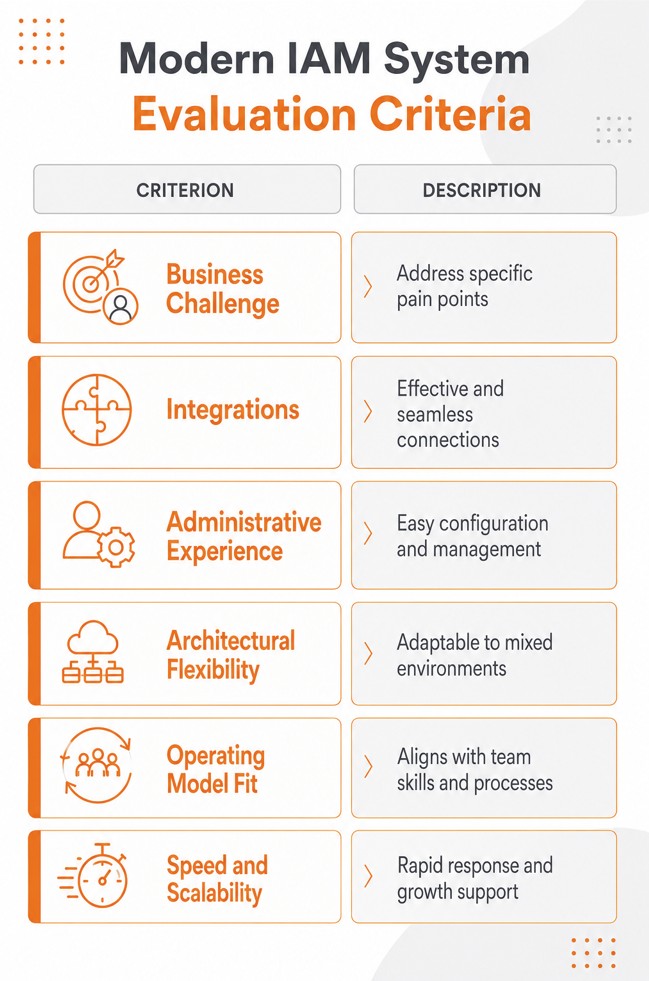
Choosing an Identity and Access Management (IAM) solution is about much more than comparing feature lists. Yet many IAM evaluations lose focus because teams begin evaluating capabilities before agreeing on the business problem they are trying to solve. One stakeholder prioritizes phishing-resistant authentication, another wants to streamline user onboarding, while others focus on compliance or reducing administrative overhead. The discussion quickly turns into a checklist exercise where every vendor appears to offer similar functionality. A more effective approach is to evaluate how well an IAM platform addresses your organization’s real-world challenges and supports future growth.
The following five considerations can help guide that decision.
1. Start with the Business Challenge
Every IAM modernization initiative begins with a specific pain point. It could be password fatigue, outdated authentication methods, inefficient onboarding and offboarding, fragmented identity management, compliance challenges, or excessive manual administration. That challenge should remain at the center of the evaluation process. If it doesn’t, organizations often end up investing in a broad platform without resolving the issue that made the project a priority in the first place.
2. Focus on the Quality of Integrations
A long list of integrations is easy to market. What matters is how effectively those integrations work in practice. Can the platform enforce consistent security policies across your critical applications? Does it integrate seamlessly with both modern cloud services and existing enterprise systems? Can it support hybrid environments without leaving security gaps?
As organizations increasingly rely on cloud-native applications, APIs, and microservices, integration capabilities have become more important than ever. Modern IAM solutions should provide comprehensive support for web, mobile, API-driven, and hybrid environments while embracing open standards such as OAuth 2.0 and OpenID Connect. Unlike many legacy IAM platforms originally designed for XML- and SOA-based architectures, modern solutions should be built to secure today’s distributed applications without limiting developers or requiring extensive customization.
3. Assess the Administrative Experience
An impressive product demonstration doesn’t always reflect the day-to-day reality of operating the platform. Consider how easily administrators can configure policies, troubleshoot issues, and manage identities after deployment. Can routine tasks be automated? Is the interface intuitive enough for existing IT and security teams, or does it require highly specialized identity expertise? An IAM solution should simplify administration, reduce operational overhead, and empower teams to manage identity efficiently as the organization grows.

4. Look for Architectural Flexibility
Deployment flexibility has become a critical consideration for modern IAM.
Very few organizations can rebuild their identity infrastructure from scratch. Most operate with a combination of legacy applications, existing directories, cloud services, and modern business applications. A modern IAM platform should integrate into this mixed environment rather than expect a perfect greenfield deployment.
Some organizations require on-premises deployments to satisfy security, resilience, or regulatory requirements. Others benefit from the agility and scalability of public or private cloud environments. Many operate in hybrid or multi-cloud architectures.
The right IAM solution should support all of these deployment models while allowing organizations to retain full control over identities and sensitive data. Modern platforms should provide the flexibility to deploy where it makes the most business sense- not force organizations into a single operating model.
5. Ensure the Solution Fits Your Operating Model
The best IAM platform is not necessarily the one with the most features – it is the one your organization can successfully deploy, operate, and maintain over the long term. Look beyond product capabilities and assess how well the solution fits your team’s skills, processes, and operational model. A successful implementation should improve security while reducing administrative complexity, accelerating service delivery, and simplifying compliance efforts.
6. Prioritize Speed and Scalability
Identity infrastructure must evolve as quickly as the business it supports. A modern IAM platform should enable organizations to respond rapidly to changing security requirements, onboard new applications faster, and adapt to evolving business needs without extensive redevelopment. Scalability is equally important. The ability to configure policies and workflows instead of writing custom code allows organizations to support increasingly complex identity scenarios while minimizing maintenance costs. Highly scalable IAM solutions centralize identity management, provide reusable APIs, enforce consistent security policies, and accelerate the delivery of new applications and digital services across the enterprise.
Building a Modern IAM Platform with PATECCO
At PATECCO, we help organizations establish a modern identity platform that grows with their business. Our approach enables you to:
- Configure identity services with minimal custom coding, even for complex use cases.
- Accelerate integration through open standards and simplify deployment across diverse environments.
- Align business requirements with IAM capabilities using proven architectural principles.
- Deploy flexibly in on-premises, cloud, hybrid, or multi-cloud environments.
- Meet regulatory requirements, including NIS2, DORA, GDPR
Final Thoughts
Selecting a modern IAM solution is about far more than comparing product features. It is about choosing a platform that aligns with your business objectives, integrates seamlessly with your existing infrastructure, scales with future growth, and can be managed efficiently over time. When evaluating potential solutions, ask one simple question: Will this platform make identity and access management more secure, easier to operate, and better prepared for future business needs?
Organizations that focus on solving real business challenges – rather than simply checking feature boxes – are far more likely to implement an IAM platform that delivers lasting value, strengthens security, supports compliance, and enables long-term digital transformation.
Click on the image to view the infographic: