
As companies work toward their digital transformation, they are using different technologies to work more efficiently and stay competitive. However, going digital also brings risks – especially when it comes to cybersecurity – and these risks are likely to increase as technology continues to advance. To stay secure and resilient, businesses need to actively prepare for and respond to constantly changing and more complex cyber threats.
The Rise of Identity-Focused Security via Managed Services
Today’s Managed Service Providers (MSPs) focused on identity management are improving enterprise security strategies. Instead of viewing identity as just one element within a broader security framework, these providers place it at the center of their approach. By doing so, they deliver robust solutions that combine strong security controls with smooth and user-friendly access experiences. Managed Service Providers play a key role in strengthening and modernizing enterprise security. They bring expertise, advanced tools, and proven practices that help organizations better manage identities and reduce risks. Below are some of the main ways MSPs improve enterprise security:
1. Centralized Identity Lifecycle Administration
Leading MSPs deploy end-to-end identity management solutions that automate and simplify the full lifecycle of user identities – from onboarding new employees to revoking access upon departure. This ensures that security vulnerabilities often linked to role changes or transitions are minimized, always maintaining appropriate access rights.
These capabilities typically include:
- Automated assignment and removal of access based on identity attributes
- Ongoing review and validation of user permissions to avoid excessive privileges
- Streamlined workflows that minimize human error and enhance efficiency
- Immediate insight into identity status across the organization
2. Adoption of Zero-Trust Security Models
Progressive MSPs guide organizations in moving beyond traditional perimeter-based defenses toward zero-trust frameworks built on the principle of “never trust, always verify.” This approach acknowledges that threats may arise both externally and internally.
Core elements of MSP based on zero-trust strategies include:
- Integration of advanced multi-factor authentication to confirm user identities through multiple layers
- Continuous verification processes that assess risk throughout user sessions
- Context-sensitive access controls that factor in device type, location, behavior, and risk level
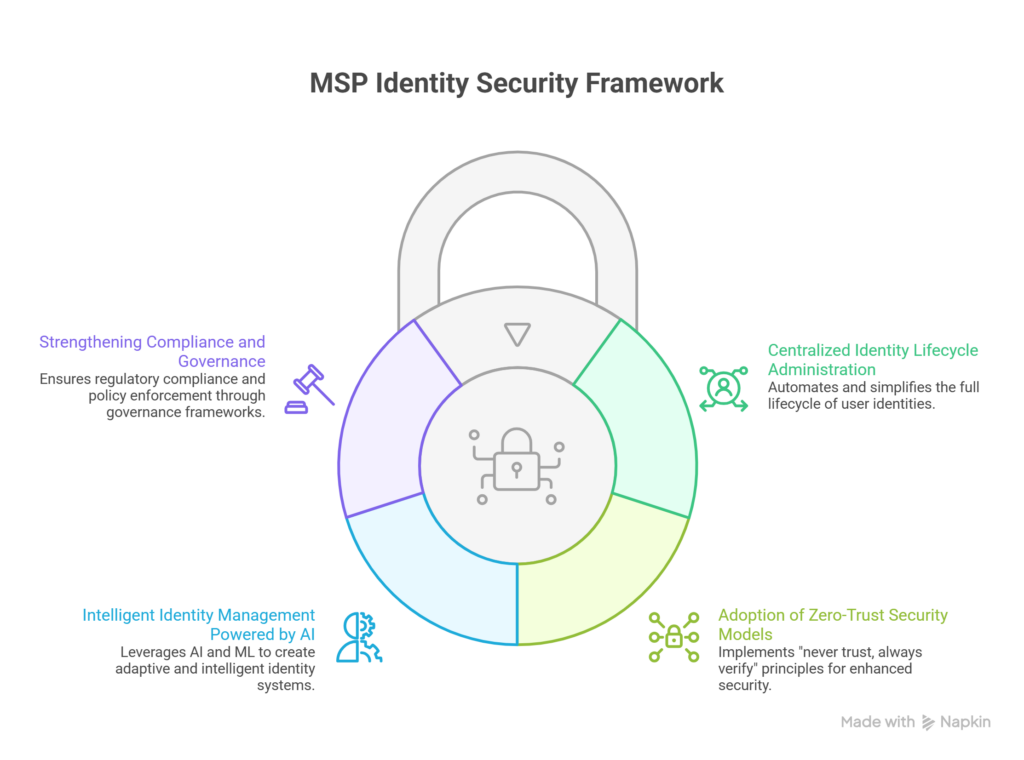
3. Intelligent Identity Management Powered by AI
Modern MSPs enhance identity systems by incorporating artificial intelligence and machine learning, transforming them into adaptive and intelligent platforms. These technologies enable:
- Detection of unusual login behaviors or suspicious access attempts
- Risk-based scoring systems that dynamically adjust security measures
- Predictive insights that identify potential threats before they materialize
- Automated handling and resolution of routine identity-related incidents
4. Strengthening Compliance and Governance
MSPs also play a crucial role in helping organizations meet regulatory and compliance requirements. By embedding governance frameworks into identity systems, they ensure consistent enforcement of policies and audit readiness.
This includes:
- Automated compliance reporting aligned with industry standards
- Policy enforcement to ensure access aligns with regulatory obligations
- Audit trails that provide transparency into user activity and access decisions
- Role-based access controls that support least-privilege principles
Key Factors to Consider the Right Identity MSP
Choosing the right identity MSP requires looking at several key areas. Organizations should assess the provider’s technical capabilities, including how complete, flexible, and secure their solutions are, as well as how well they integrate with existing systems. It’s also important to evaluate their operational performance, such as implementation methods, support quality, service reliability, and monitoring tools. Finally, businesses should consider how well the MSP aligns with their long-term goals, including industry expertise, readiness for what’s next, and whether the provider views identity management as a strategic part of the business rather than just a technical function.